
I still remember the sound—a dull, sickening thud followed by the unmistakable clink of a tooth hitting the turf during my son’s Saturday soccer game. In that split second, the air left my lungs. There he was, holding his mouth, while a perfectly good permanent incisor sat nestled in the grass like a lonely pebble. I panicked. I did exactly what you shouldn’t do: I grabbed it by the root and tried to scrub the dirt off with my shirt. Looking back, that was my biggest mistake. I thought I was cleaning it, but I was actually destroying the microscopic ligaments needed for reattachment. That day was a brutal lesson in emergency dental care, but it’s a mistake you don’t have to make. Today, I’m going to walk you through the high-stakes minutes following a dental injury so you can act with the confidence I didn’t have back then. We’re going to ensure that a sports injury doesn’t turn into a permanent gap in your family’s smiles.
Pick It Up by the Crown or Lose It Forever
When you’re standing on a field with a crying kid, your instincts might betray you. You need to remember one thing: the root is the ‘heart’ of the tooth. Touching it is like touching a burnt nerve. You must only ever handle the tooth by the chewing surface, or the crown. My early failure taught me that even the most well-intentioned cleaning can be fatal to the tooth’s survival. If the tooth is dirty, give it a very gentle five-second rinse with milk or water. Whatever you do, do not use soap, and for heaven’s sake, do not scrub it. If you have been following my advice on how to protect your teeth while playing high-impact sports, you know that prevention is better than a cure, but life happens fast. According to the American Association of Endodontists, a tooth has the highest chance of being saved if it is replanted by a professional within 60 minutes of being knocked out.
Can a tooth really be put back in after it hits the dirt?
It sounds like science fiction, doesn’t it? Many parents I talk to are convinced that once a tooth is out, it’s out for good. But the mouth is incredibly resilient. If you can keep those periodontal ligament cells alive, a dentist can often splint the tooth back into place, where it will eventually re-integrate with the bone. It is part of the magic of modern family dentistry. If you can’t immediately put the tooth back into the socket yourself, you need to know the best way to store a broken tooth until you get to the office. Have you ever had to deal with a dental emergency in the middle of a game? It’s a total adrenaline rush, and not the good kind. Setting the stage for a successful rescue starts with staying calm and having a plan before the whistle even blows.The first thing you have to realize is that a tooth isn’t just a piece of calcium; it is a living organ attached by tiny, microscopic fibers. When it gets knocked out, those fibers are literally screaming for moisture. If they dry out, they die, and the body will eventually reject the tooth like a splinter. Think of the tooth root like a delicate sea creature—it needs to stay in its natural ‘ocean’ to survive the trip to the dentist. One of the most common oral health myths debunked: what you need to know in 2025 is that you should ‘clean’ the tooth with alcohol or peroxide. Never do this. You are effectively chemical-burning the very cells that allow for reattachment.
Try Replanting the Tooth Yourself Right Away
If you are brave and the tooth is relatively clean, the best storage container is the hole it just came out of. I know, it sounds gruesome. But the natural socket provides the perfect pH and temperature. Gently push the tooth back in, making sure it is facing the right way—look at the neighboring teeth for a guide—and have the person bite down on a piece of gauze or a clean handkerchief to hold it. This is a core part of preventive tips for long-lasting dental health for families because it bypasses the need for external storage and keeps the ligaments alive in their original environment. 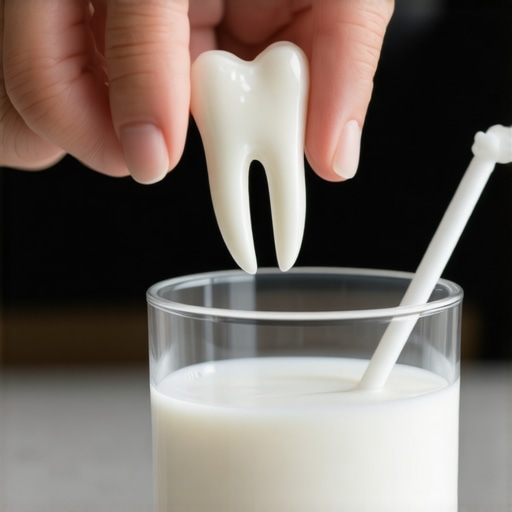
What to Do When the Tooth Won’t Go Back In
Sometimes, the gum is too swollen or the person is too distressed to let you jam the tooth back into the socket. In that case, you need a backup plan. Last summer, my nephew Leo face-planted while chasing his dog and sent his front tooth flying onto the patio. He was hysterical, so there was no way we were getting that tooth back in the socket on-site. I grabbed a clean coffee mug, filled it with cold milk, and dropped the tooth in. Why milk? It has a chemical makeup that keeps the cells on the root alive longer than plain water, which actually causes the cells to burst and die. If you don’t have milk, use a container with the person’s own saliva. This is widely considered the best way to store a broken tooth until you get to the office.
The Sixty-Minute Race Against Time
You have a very narrow window before the biological clock runs out. While you are on the way to the clinic, call ahead. Tell the office it is an ‘avulsed permanent tooth.’ Most family dentistry practitioners will clear their schedule for this specific emergency. If you are wondering about the long-term impact, remember that how regular dental cleanings can save you money in the long-run also applies to avoiding expensive implants later by saving your natural tooth now. If you are a sports family, keep a small bottle of saline or a tooth-saver kit in your bag alongside your gear as part of your strategy for how to protect your teeth while playing high-impact sports. Leo’s tooth was back in his mouth and splinted within 45 minutes, and today, you would never know it was ever missing.
While saving a knocked-out tooth is the ultimate emergency, the mistakes I see most often in my office aren’t sudden accidents—they are the slow, silent errors people make in their daily routines. Most of my patients come in thinking they are overachievers because they scrub their teeth until they squeak. But here is the nuance: ‘squeaky clean’ is often the sound of your enamel being worn away. In my years of practice, I’ve found that the biggest misconception in family dentistry is that more force equals more health.
Why your ‘perfect’ hygiene routine might be destroying your enamel
Everyone says you should brush right after every meal to keep things pristine, but in my experience, that is one of the most dangerous pieces of advice. If you’ve just finished a bowl of fruit or a glass of soda, your enamel is temporarily softened by the acid. If you brush immediately, you are essentially sandpapering your teeth. This is exactly why we recommend waiting thirty minutes to brush after eating fruit. It gives your saliva time to remineralize the surface. Another trap is the ‘natural’ trend. I often hear parents asking about the Journal of the American Dental Association findings on alternative therapies, and many are surprised to learn that the truth about oil pulling for dental health is that it doesn’t replace mechanical cleaning or flossing. It’s an ‘extra,’ not a substitute.
Can you actually whiten your way into a dental emergency?
This is the sophisticated question I get from patients who are deep into cosmetic dentistry trends. They want that Hollywood glow, but they don’t realize that aggressive DIY whitening can cause microscopic porousness in the tooth structure. If you are constantly using abrasive charcoal pastes or high-acid home kits, you might notice the reason your teeth look yellow even though you brush twice daily is actually because you’ve worn your white enamel so thin that the yellowish dentin underneath is showing through. It’s a paradox: the harder you try to whiten, the more ‘yellow’ you become.
Stop scrubbing and start thinking about pH balance
In oral health, pH is king. A study by the American Academy of Periodontology highlights that a chronic acidic environment is more damaging than occasional sugar intake. When you use a stiff brush to fight this acidity, you accelerate the damage. This is why your gums recede faster if you use a hard-bristled brush; you are literally pushing the gum line away from the tooth. We should be treating our gums like silk, not like a dirty floor that needs scouring. If you’re looking to save money, remember how regular dental cleanings can save you money in the long-run by catching these subtle wear patterns before they require crowns or grafts. Have you ever fallen into the trap of ‘over-brushing’ or trying a ‘natural’ hack that backfired? Let me know in the comments.
Moving beyond the ‘scrubbing’ habit requires a bit of a hardware upgrade. If you are serious about oral health, you need to stop thinking of your toothbrush as a manual tool and start viewing it as a piece of precision machinery. I personally made the switch to a high-end electric brush with a pressure sensor three years ago because I realized I was part of the problem—I was pressing too hard without even knowing it. This is exactly how to choose the right toothbrush bristle strength for your gums to prevent self-inflicted recession.
Get the tools that professional hygienists use at home
The one tool that changed everything for my family was the water flosser. My youngest used to treat traditional floss like a torture device, but now it’s just part of the routine. I recommend it because it reaches the subgingival areas that string simply can’t touch, which is vital for the benefits of using a water flosser for patients with gum disease. If you have any hardware in your mouth—like braces or a bridge—this isn’t an ‘extra’ tool; it is a necessity. It prevents that dreaded ‘old food’ smell and keeps the surrounding tissue pink and tight, helping you learn how to stop your dental crown from smelling like old food before it becomes a social disaster.
How do I maintain my dental work over a lifetime?
Maintenance is where most people drop the ball. They spend thousands on cosmetic dentistry and then treat those results like they are invincible. Whether you have implants or contouring veneers, the biological environment around them is still susceptible to bacteria. To keep things pristine, you need to master how to maintain your porcelain veneers so they last twenty years, which involves non-abrasive pastes and avoiding night-time grinding. If you are a grinder, don’t skip the nightguard; it is the cheapest insurance policy you will ever buy for your smile. Beyond the physical tools, we are seeing a massive shift in family dentistry toward precision diagnostics. For instance, why our Culpeper practice won’t place a dental implant without a cbct scan is because 3D imaging allows us to see bone density in ways a 2D X-ray never could.
The future of family dentistry is already here
I predict that within the next five years, we will see AI-integrated toothbrushes that provide real-time pH monitoring of your saliva. Until then, we rely on the philosophy of ‘Minimal Intervention Dentistry,’ a concept championed by the FDI World Dental Federation. This approach focuses on keeping as much of your natural tooth structure as possible through advanced tech like how we use laser dentistry to treat gum disease without scalpels. By using light energy instead of steel, we can target bacteria while leaving healthy tissue completely untouched. It is a game-changer for anyone who has ever feared the dentist’s chair. This is why I always tell my patients that how regular teeth cleaning can prevent major dental issues is the most effective way to scale your health without scaling your costs. My challenge to you: Go check your toothbrush today. If the bristles are splayed out like a tired broom, replace it immediately and try holding it with just two fingers to reduce your pressure. You’ll be amazed at how much better your gums feel in just a week.
The Hardest Lessons I Learned Managing My Own Family’s Dental Health
Reflecting on my own journey, I realized that oral health is less about the intensity of the scrub and more about the consistency of the habit. One of the biggest oral health myths busted for me was the idea that dental visits are just for when things hurt. I’ve learned that the most expensive problems are the ones that were silent for years. We often overlook how maintaining perfect oral health as a family requires a collective mindset shift—it’s not a chore, it’s a form of self-respect. Finally, don’t let the quest for a ‘Hollywood’ look distract you from the foundation; health always looks better than artificial perfection.
A Few Tools That Actually Make a Difference Every Morning
If you want to move beyond basic brushing, I recommend focusing on precision. Start with the ultimate guide to teeth cleaning techniques to ensure your manual skills are up to par. For my own kit, I rely on a pressure-sensing electric brush and a quality water flosser. I also suggest reading up on expert advice for a lifetime of healthy teeth to understand the ‘why’ behind the ‘how.’ These aren’t just gadgets; they are the frontline defense against periodontal disease and enamel wear.
Let’s Change the Way Your Family Views the Dentist
You have the power to turn dental care from a source of anxiety into a routine win for your health. Whether it’s choosing better tools or debunking long-held myths, every small change adds up to a lifetime of confident smiles. Your teeth are meant to last a lifetime, and with a little bit of mindful care, they absolutely will. Take that first step today—your future self will thank you for the effort. Have you ever tried a dental hack or a new tool that completely changed your morning routine? Let me know in the comments below!