
I’ll never forget the time I spent an entire romantic dinner at a fancy steakhouse feeling like a million bucks, only to get home and realize I’d been sporting a giant piece of spinach tucked behind my lower teeth the whole time. My permanent retainer—that tiny metal bar I thought was my best friend—had betrayed me. It wasn’t just the embarrassment; it was the realization that my mouth had become a miniature compost bin for the last three hours. If you’ve got a lingual wire, you know exactly what I’m talking about. It’s great for keeping your smile straight, but it’s a nightmare for everything from crusty bread to sesame seeds.
That Wire is a Magnet for Everything You Eat
Most people think getting their braces off is the finish line, but then you get that permanent wire glued to the back of your teeth. Suddenly, you’re dealing with a whole new level of maintenance. I used to think I could just brush over it and call it a day. I was wrong. My dentist actually had to sit me down after a check-up and show me the “calculus bridge” I was building. It turns out, research published by the National Center for Biotechnology Information indicates that fixed retainers significantly increase the risk of plaque accumulation and calculus formation compared to teeth without them (source: https://www.ncbi.nlm.nih.gov/pmc/articles/PMC4312674/). I learned the hard way that maintaining oral health requires more than just a quick swish of water. Today, I’m going to share the exact routine I use to make sure my retainer stays a tool for beauty, not a trap for bacteria. We’re going to talk about the tools that actually work and the habits that will save you from an awkward “you have something in your teeth” conversation later.
Does This Little Wire Actually Cause More Trouble Than It Is Worth?
You might be wondering if you should just have the thing ripped out. I get it. The frustration is real when you feel food stuck deep in your gums and realize it’s wedged right under the wire. But here is the reality: without it, your teeth will move. I have seen friends ignore their teeth-keeping tips after braces, and within a year, their bottom teeth looked like a deck of cards being shuffled. The wire is worth the hassle, but only if you know how to outsmart it. Have you ever had one of those “spinach-in-the-teeth” moments that made you want to hide under a rock? Drop a comment and tell me I am not the only one.
Stop Letting Your Dinner Live Under Your Teeth
When I first got my retainer, I made the classic rookie mistake of thinking a standard toothbrush could reach those hidden nooks. It cannot. The wire creates a physical barrier that shadows your enamel, creating a “safe zone” for bacteria to thrive. This is how people end up needing regular teeth cleaning way more often than they expected. You need to approach that wire like a specialized cleaning project, not just a part of your general brushing routine.
Three Essential Tools That Make Wire Maintenance Actually Possible
Think of your permanent retainer as a low-hanging bridge over a busy highway. You cannot just drive a massive semi-truck—like thick, traditional floss—under it without scraping the roof or getting stuck. You need a specialized vehicle for this terrain. One Tuesday morning, I was rushing for a job interview and tried to force a piece of regular waxed floss under the wire. It shredded instantly. I spent twenty frustrating minutes with tweezers trying to pick out tiny blue wax fibers while my gums turned bright red. That was the day I realized that shortcuts are actually just long-cuts in disguise. To avoid a similar disaster, you must adopt family dentistry tips that make oral care effortless and effective by using the right equipment for the job.
Master the Art of the Floss Threader
The floss threader is essentially a flexible plastic needle. You loop your floss through the eye of the threader and pass the plastic tip under the wire. Once it is through, you can move the floss up and down the sides of your teeth as if the wire wasn’t even there. This mimics the move to clean under your dental bridge safely, which is a vital skill for anyone with fixed hardware. If you find the threading process too tedious, look into ‘Superfloss’—it comes with a pre-stiffened end that eliminates the need for a separate threader.
Why You Should Trade Your Floss for a Water Jet
If the thought of manually threading floss every night makes you want to skip it entirely, a water flosser is your new best friend. It uses a concentrated stream of pressurized water to blast out food particles that a toothbrush cannot reach. This is especially helpful for those with gentle teeth cleaning best practices for sensitive gums because it provides a deep clean without the mechanical friction of string. I personally found that using a water flosser reduced my bleeding gums within just two weeks of consistent use. 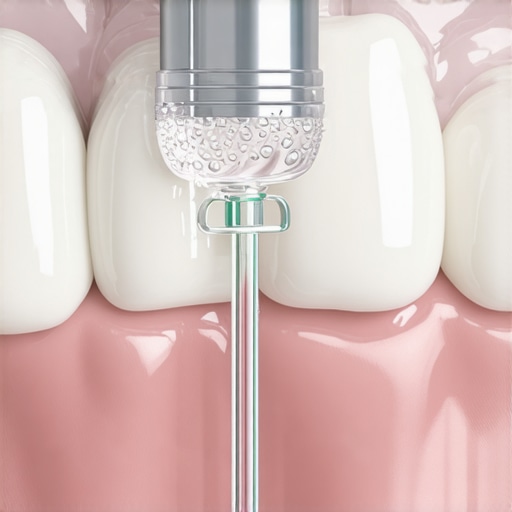
The Tiny Brush You Did Not Know You Needed
Interdental brushes look like miniature mascara wands or tiny Christmas trees. They are designed to slide into the gaps between your teeth, right at the gum line. Because the retainer wire sits slightly away from the tooth surface in certain spots, these little brushes can scrub the back of the wire where plaque loves to hide. Incorporating these into your routine is one of the top 5 secrets to maintaining perfect oral health as a family. It is about precision rather than power. You are not trying to saw through your teeth; you are gently whisking away the debris that leads to tartar.
Stop Plaque Before It Becomes Stone
Once plaque sits on your wire for more than 24 to 48 hours, it begins to mineralize into calculus (tartar). At that point, no amount of home scrubbing will remove it. This is why smile bright revolutionary teeth cleaning techniques for 2025 emphasize daily prevention over reactive cleaning. When you use these specialized tools, you aren’t just cleaning for today; you are preventing the ‘calculus bridge’ that can eventually pull on your gums and lead to recession. If you have noticed any roughness when you run your tongue over the wire, it is a sign that the mineralization process has already started.
That “calculus bridge” I mentioned isn’t just a maintenance issue; it’s the tip of the iceberg when it comes to the misconceptions we carry about our teeth. We often treat cosmetic improvements and oral health as two separate worlds—one for vanity and one for vitality. In my experience, this is the biggest mistake you can make. I’ve seen countless people spend thousands on cosmetic dentistry innovations you can’t miss this year, only to let the underlying foundation crumble because they thought the “pretty” parts didn’t need the same grit as the “healthy” parts.
The Vanity Paradox and Why Beauty Saves Your Health
Here is a contrarian take: Cosmetic dentistry is actually one of the best tools for preventive health. Everyone says vanity is a vice, but when it comes to your mouth, it’s a powerful motivator. A study by the American Academy of Cosmetic Dentistry (AACD) suggests that patients who are satisfied with the appearance of their smile are significantly more likely to adhere to rigorous hygiene protocols. When you love the way your teeth look, you’re far more likely to spend those extra minutes with the water flosser. We need to stop viewing the impact of cosmetic dentistry as purely superficial and start seeing it as the behavioral glue that keeps us flossing. Have you ever noticed yourself taking better care of your teeth right after a cleaning or a whitening session? Let me know in the comments if a little “vanity” helped you stay on track.
Why your smile appears crooked in selfies but not the mirror
This is a question that plagues almost everyone who has ever tried to document their dental progress. You look in the bathroom mirror and see a perfectly aligned row of teeth, but the moment you open your camera app, everything looks off-center. This isn’t usually a dental problem; it’s a lens physics problem. Front-facing smartphone cameras often have a slight wide-angle distortion that can exaggerate minor asymmetries. Understanding why your smile appears crooked in selfies but not the mirror is crucial before you go chasing corrective treatments for a problem that might not even exist in real life. 
The Dangerous Trap of the Kitchen Pantry Dentist
The “oops” factor often hits when people try to bypass professional advice for “natural” hacks. I’ve met people who swear by scrubbing their teeth with lemon juice or charcoal, but they are essentially sandblasting their enamel. One of the most persistent oral health myths debunked is the idea that baking soda is a safe, daily toothpaste substitute. While it can remove stains, the truth about using baking soda as a toothpaste is that its abrasiveness can lead to permanent thinning of your enamel, especially if you have a receding gum line. If you’re dealing with thin enamel, you need to look into the safest way to whiten teeth rather than reaching for the box in your cupboard. Even common products like whitening strips can be a trap if you apply them over areas where your gums recede, leading to sharp, shooting nerve pain. Real expertise means knowing when to put the DIY kit down and realizing that how regular dental cleanings can save you money by preventing the massive repair bills that follow “natural” mistakes.
If you have invested time and money into your smile, you need to stop treating your bathroom cabinet like a bargain bin. I’ve transitioned almost exclusively to high-performance oscillating brushes because the mechanical action is far more forgiving on hardware than my old manual scrubbing. I personally use a model with a built-in pressure sensor—not because I’m a novice, but because when I’m tired at 11 PM, I tend to push too hard. Over-brushing is a silent killer for dental work, and using the best toothbrush texture for people with receding gums is the only way to avoid wearing down your enamel. In fact, a study published in the Journal of Clinical Dentistry confirmed that oscillating-rotating electric toothbrushes removed significantly more plaque than manual brushes over a 12-week period, specifically targeting the gingival margin where retainers and crowns often fail. This isn’t just about cleaning; it is about protecting the structural integrity of your investment.
Stop Gambling with Manual Brushes and Weak Floss
The biggest mistake I see is people thinking they can out-skill a manual brush. You can’t. Specialized tools like the AirFloss or high-pressure water jets allow you to reach areas that string simply cannot penetrate, especially around contouring and veneers. I’ve found that incorporating a pH-balancing mouthwash after my morning coffee has been a game-changer. Most people don’t realize that the acidity from coffee lingers for hours, slowly softening your enamel. By neutralizing that acid immediately, you’re providing preventive tips for long-lasting dental health for families that actually work in the real world. #IMAGE_PLACE_HOLDER_D#
How do I maintain my dental results over a decade?
Maintenance is a marathon, not a sprint. It requires a combination of high-tech home care and a commitment to professional oversight. You should be viewing your dental office as a partner in performance, not a place you go when something breaks. Integrating the ultimate guide to teeth cleaning techniques into your daily life means using interdental brushes to clear out the “black triangles” that can form as we age. Furthermore, how regular dental cleanings can save you money is through the early detection of micro-fractures in fillings or slight shifts in tooth position that a retainer might be causing. If you aren’t checking the fit of your hardware every six months, you are leaving your smile’s future to chance.
The Next Frontier of Smart Mouth Tech
Looking ahead, I predict we are moving toward a world where your toothbrush doesn’t just buzz; it analyzes. We are already seeing the emergence of AI-integrated brushes that map your mouth in real-time to ensure 100% coverage. In the next few years, I expect these devices to sync with your dentist’s software, flagging inflammation markers in your saliva before you even feel a twinge of pain. This shift toward biometric oral data will make cosmetic dentistry innovations even more durable because we will be treating the biological environment, not just the teeth themselves. If you want to stay ahead of the curve, swap your manual brush for a pressure-sensing electric model this week—it is the single most effective way to ensure your smile remains a masterpiece for years to come.
The Truth About Living with a Lingual Wire
I’ve realized that a permanent retainer isn’t a set-it-and-forget-it solution; it’s more like a vintage car that requires a specific kind of maintenance. First, the Sugar Trap is very real—acidic drinks like coffee or soda can linger behind the wire, softening your enamel in places you cannot see. Second, I learned that a magnifying mirror is your best friend. It feels like a horror movie at first, but seeing the early stages of plaque allows you to adjust your technique before it hardens into a calculus bridge. Lastly, consistency beats intensity every time. Five minutes of gentle, focused care is worth more than an hour of aggressive scrubbing that only leads to gum recession.
The Arsenal That Actually Keeps My Smile Intact
If you want to stop plaque before it starts, you need the right gear. I personally swear by the Waterpik Cordless Advanced because it delivers the pressure needed to clear debris from the wire without the frustration of shredded floss. I also keep a pack of TePe Interdental Brushes in my bag; they are the precision snipers of dental hygiene, reaching the gaps that standard brushes ignore. For the heavy lifting, I use an oscillating electric brush with a pressure sensor to protect my enamel while I follow the ultimate guide to teeth cleaning techniques and benefits. These aren’t just gadgets; they are the barrier between you and an expensive corrective procedure. These tools represent the top 5 secrets to maintaining perfect oral health as a family, ensuring everyone stays on track.
Turn Your Routine Into a Ritual for Longevity
Maintenance does not have to be a chore—it is an act of self-respect. When you prioritize maintaining oral health, you are not just protecting your teeth; you are preserving your confidence and your future health. Remember that how regular dental cleanings can save you money in the long run is by catching the tiny shifts or mineral deposits before they become massive problems. You have already done the hard work of getting your smile where it is—now, give it the daily care it deserves to stay that way. Your future self, and your dentist, will thank you. Have you found a specific tool or trick that makes cleaning around your retainer easier? Let me know your best hacks in the comments below!