
I remember sitting on the floor with my two-year-old, Leo, trying to get him to say “apple.” He looked at me with such determination, but the sound just wouldn’t come out right. It wasn’t just typical toddler babble; it felt like his tongue was physically tethered to the floor of his mouth. I spent weeks spiraling, wondering if I had failed at some basic parenting milestone, before a friend mentioned her own daughter’s struggle with a tongue tie. I felt like a lightbulb finally flickered on in a dark room. If you are watching your little one struggle with speech or even basic chewing, you aren’t alone, and you aren’t imagining things. Today, I want to help you identify those subtle signs I missed so you can get your toddler the help they need without the months of second-guessing I went through.
Why I Refused to Believe My Toddler Had a Physical Restriction
Early on, I made the mistake of thinking that as long as he was gaining weight, everything was fine. I completely ignored the way his tongue shaped into a heart whenever he tried to stick it out. It turns out, identifying a tongue tie—or ankyloglossia—isn’t always about breastfeeding hurdles in infancy. It often shows up later when they start exploring solid foods and complex speech sounds. If you’ve been following family dentistry tips that make oral care effortless, you might still miss this because it’s a structural issue, not a hygiene one. According to the Mayo Clinic, a tongue tie can significantly restrict the tongue’s range of motion, affecting how a child eats, speaks, and even swallows. I’ve seen many parents wonder why your dentist wants to check your tongue for spots or movement, and this is exactly why. The tongue is vital for more than just tasting; it’s a mechanical tool for development. To make the evaluation visit go smoother, you can even check out the trick to getting toddlers to sit still for their first cleaning so the dentist can get a good look at that lingual frenulum.
Is This Just a New Parenting Trend?
I hear this a lot from skeptical grandparents: “In my day, we didn’t worry about tongue ties!” But the reality is that we simply know more now about how oral structure affects long-term health. It’s not a fad; it’s about ensuring your child can transition to solid foods without choking risks and speak clearly enough to be understood by their peers. Building a foundation of healthy smiles for all ages means looking at the whole mouth, including the way the tongue moves. Have you ever noticed your child struggling with specific ‘D’ or ‘L’ sounds, or perhaps they seem to ‘pocket’ food in their cheeks like a little squirrel? Tell me, have you seen these signs and felt like you were just being over-analytical? Believe me, your gut instinct is usually right.
Watch for the Tongue Tug-of-War
To understand what is happening in your toddler’s mouth, think of the tongue as an athlete held back by a short leash. When a child has a tongue tie, that little string of tissue called the lingual frenulum is too tight, too short, or attached too far forward. I remember trying to play copycat with Leo in front of the bathroom mirror. I would stick my tongue out far, and he would try so hard to mirror me, but his tongue would just barely clear his lips and then pull into that tell-tale heart shape at the tip. This happens because the center is being pulled back by the restriction while the sides try to move forward. You can perform a simple check at home by gently lifting your child’s tongue with a clean finger while they are lying down. If the tongue stays stuck to the floor of the mouth or forms a distinct V or heart shape instead of lifting toward the roof, you are likely looking at a physical restriction rather than a simple developmental delay. 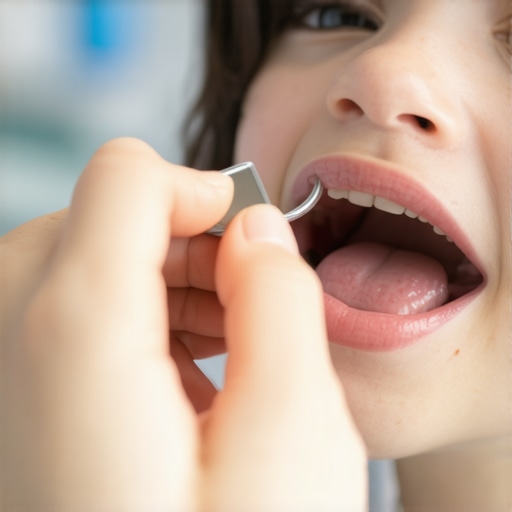
Test Their Range of Motion with a Simple Snack
If a visual check is too difficult—because let’s be honest, toddlers are not known for holding still—you can use food as a diagnostic tool. Take a tiny bit of peanut butter or yogurt and dab it on their top lip, right in the center. Watch how they try to lick it off. A child with a full range of motion will sweep their tongue up and across easily. A child with a tie might use their bottom lip to scrape the top one or move their whole head forward to reach the food. I saw this clearly when Leo tried to eat a grape; he could not move the fruit to his back molars to chew it, so he just kind of gummed it in the front until it fell out of his mouth. This lack of lateral movement is one of the biggest oral health myths busted: many people think it is just a picky eater phase, when it is actually a mechanical struggle. When the tongue cannot sweep the teeth, food stays stuck, which is why learning how to stop your kids from getting cavities between their teeth becomes even more critical for kids with these restrictions.
Why a Dentist Sees What a Doctor Might Miss
You might wonder why your pediatrician did not catch this during a well-check visit. Often, medical doctors are looking for weight gain and general growth, but a dentist specifically looks at the architecture of the oral cavity. When you are determining how to tell if your child is ready for their first dental cleaning, consider that this visit is the perfect time for a functional assessment. A dentist evaluates how the tongue position affects the palate, which is the roof of the mouth. If the tongue cannot rest against the palate, the jaw might grow narrow over time, leading to crowded teeth. This is why why your dentist wants you to use a tongue scraper or check your tongue movement is about more than just fresh breath; it is about ensuring the self-cleaning mechanism of the mouth works. Without that sweeping motion, the benefits mentioned in the ultimate guide to teeth cleaning techniques and benefits are harder to achieve because the tongue is not doing its natural job of clearing debris. During our first real consultation, the dentist explained that a tongue tie can cause a tongue thrust where the tongue pushes against the teeth instead of the roof of the mouth, potentially changing the shape of the face. If you have been researching preventive tips for long-lasting dental health for families, understanding this structural component is step one. It is not just about the brush and floss; it is about the mechanics of the mouth working in perfect harmony.I’ve heard it a thousand times: “If they can talk, the tie isn’t a problem.” But this is the biggest myth in modern pediatric care. A tongue tie isn’t just about the “L” and “R” sounds; it’s fundamentally about the airway. When the tongue is tethered to the floor of the mouth, it cannot rest where it belongs—against the roof of the mouth. This seemingly small structural detail dictates how the jaw develops and, more importantly, how your child breathes while they sleep. If you’ve noticed your little one snoring or mouth-breathing, you’re seeing the fallout of an oral restriction that hygiene alone can’t fix. This is one of the top 5 secrets to maintaining perfect oral health as a family: looking beyond the teeth to the functional space of the mouth. This perspective is central to oral health myths debunked: what you need to know in 2025, where we move past simple brushing and into the realm of structural integrity.
Why Does My Child Still Struggle After the Tongue Tie Release?
One of the biggest “traps” parents fall into—and I almost did too—is thinking the procedure is the finish line. You find a specialist, they perform the release, and you think you’re done. But the tongue is a muscle with a very long memory. If that muscle has been restricted for two or three years, it doesn’t magically know how to move correctly just because the “string” is cut. Without myofunctional therapy or specific post-procedure exercises, the tissue can actually re-attach, sometimes tighter than before. This is the “Oops” factor that leads to failed outcomes. Advanced research, such as studies cited by the American Academy of Sleep Medicine, highlights that untreated oral restrictions are a significant risk factor for pediatric obstructive sleep apnea. It’s why the reason your dentist asks about your snoring habits is so vital; they are looking for signs that the airway is compromised.  Another nuance often missed is the connection to grinding. Have you noticed why your child is grinding their teeth during their nap? In many cases, grinding is the body’s desperate attempt to move the lower jaw forward to open a restricted airway. It’s a red flag, not a “cute” toddler habit. When we talk about maintaining oral health: expert advice for a lifetime of healthy teeth, we have to include the stability of the jaw and the quality of sleep. The standard advice to “wait and see” is often rooted in outdated metrics like weight gain. If a child is growing, many practitioners assume the tie isn’t “significant.” However, this ignores the hidden cost of compensation. When a child has to work twice as hard to perform a basic function like swallowing, they develop neurological pathways that are incredibly difficult to untrain. They might learn to use their neck muscles to help them swallow, leading to chronic tension and postural issues. If your child is struggling with sensitivity after trying to keep up with hygiene, look into gentle teeth cleaning best practices for sensitive gums, but don’t let that distract you from the underlying structural struggle. By integrating preventive tips for long-lasting dental health for families, you ensure that you aren’t just treating symptoms, but fostering a healthy airway and facial development. We need to stop treating the mouth like a collection of separate parts and start seeing it as a gateway to overall health. Have you ever fallen into the trap of thinking a dental issue was “just a phase” only to realize there was more to the story? Let me know in the comments.
Stop the Re-attachment Before It Starts
I learned the hard way that a successful procedure is only twenty percent of the battle. The real work happens in your living room, during those giggly, sometimes messy follow-up exercises. To keep the tongue from simply re-attaching to the floor of the mouth, you have to be consistent with stretching and strengthening. This isn’t just about ‘healing’; it’s about re-training the brain. When you look into family dentistry tips that make oral care effortless and effective, you’ll find that consistency is the common thread. We used a small, medical-grade silicone tool to gently lift Leo’s tongue three times a day. It felt like a chore at first, but seeing him finally able to lick an ice cream cone made every minute worth it. If you are focused on maintaining oral health: expert advice for a lifetime of healthy teeth, you must view these post-op exercises as a non-negotiable part of the recovery phase.
How do I maintain these functional results over time?
The key to long-term success is integration. We stopped treating ‘exercises’ as a separate event and started making them part of our daily play. For example, we used ‘button pulls’ to strengthen his lip seal, which is a technique recommended by the Academy of Orofacial Myofunctional Therapy (AOMT) to ensure the Four Pillars of oral health: nasal breathing, lip seal, tongue on the palate, and correct swallowing. By turning these into family dental care hacks to keep your kids smiling daily, the resistance faded. You might also find that using revolutionary teeth cleaning techniques for 2025, like specialized soft-bristle brushes for post-surgical areas, helps keep the site clean without causing discomfort. 
Your home tool kit needs a functional upgrade
Forget the standard toothbrush for a moment. If you are dealing with structural issues, you need tools that challenge the tongue’s proprioception. I started using ‘Chew Tubes’ and textured teething toys to encourage Leo to move his tongue laterally. This is a crucial step in the ultimate guide to teeth cleaning techniques and benefits because a mobile tongue naturally cleans the surfaces of the teeth. I predict that in the next few years, we will see ‘smart’ pacifiers and teethers equipped with sensors to track a child’s suction and tongue pressure, sending data directly to your dentist’s smartphone. This shift toward bio-feedback will make it much easier to catch oral health myths busted by hard data. For now, your best tool is observation. My best advice? Try the ‘peanut butter sweep’ tonight: put a tiny dab of a favorite sticky snack on the roof of your child’s mouth behind their front teeth and see if they can clear it using only their tongue. It is a simple, effective way to gauge their progress at home.
The Hardest Truths I Learned While Watching My Son Heal
Reflecting on Leo’s journey, I realized that a tongue tie isn’t just about ‘the snip.’ First, I had to accept that a child can look perfectly healthy while struggling with internal mechanics. Second, I saw how compensation—like tension in the neck or jaw—can hide the real issue for years. Third, I learned that ‘waiting and seeing’ is rarely the best path for a child’s airway development. Finally, I discovered that consistency in exercises is the secret to maintaining oral health: expert advice for a lifetime of healthy teeth.
My Personal Recovery Survival Kit for Toddlers
To navigate the recovery, I built a toolkit that changed everything. I found an amazing Myofunctional Therapist whose guidance was far more valuable than the procedure alone. We also used medical-grade silicone tools for tactile stimulation and family dental care hacks to keep your kids smiling daily, like turning stretches into a game of ‘copycat.’ I also prioritized gentle teeth cleaning best practices for sensitive gums to ensure his mouth felt safe and comfortable throughout the healing process. #IMAGE_PLACE_HOLDER_E#
Giving Your Child the Gift of a Functional Smile
Addressing an oral restriction is one of the most proactive things you can do for your child’s future. By looking beyond the surface and following the top 5 secrets to maintaining perfect oral health as a family, you are protecting their sleep, their speech, and their confidence. Remember, you are your child’s best advocate. Don’t be afraid to ask for a functional evaluation if your gut tells you something is wrong. Have you ever noticed your toddler struggling with a specific food texture or sound, and did you find that a physical check helped clear up the mystery? Let me know below!