
I spent three months popping ibuprofen like it was candy. Every afternoon, like clockwork, the pressure behind my eyes would build until I had to dim the lights and pray for sleep. I blamed my laptop, my posture, and even the extra-bold roast I’d started buying. I never once suspected that the silver filling sitting in my lower molar was the secret architect of my misery. It wasn’t until I finally sat in the dentist’s chair—mostly for a routine teeth cleaning—that I realized my migraines weren’t a brain problem; they were a bite problem. My biggest mistake was treating the symptoms for months while ignoring the mechanical failure happening right inside my mouth.
Stop Chasing Migraine Cures and Check Your Fillings
The connection between your dental work and your head pain is much closer than most people realize. When a filling is just a fraction of a millimeter too high, it throws your entire jaw out of alignment. Think of it like a pebble in your shoe. You don’t just feel it in your foot; you start walking differently, your hip starts to ache, and eventually, your back is in knots. Your mouth works the same way. If you’ve ever noticed that your bite feels off after a procedure, your jaw muscles are likely working overtime to compensate. According to the American Journal of Orthodontics and Dentofacial Orthopedics, even minor occlusal interferences can lead to significant muscle activity changes, which often manifest as chronic tension headaches.
Is it even possible for a tiny piece of metal to cause a massive headache?
It sounds like a stretch, doesn’t it? I was the biggest skeptic until I learned about the temporomandibular joint. Your jaw is a complex system of muscles and nerves. When a filling—especially an older one—starts to wear down or was never perfectly leveled, it forces those muscles to stay on even when you’re resting. Have you ever felt like your teeth feel tight or noticed a strange sensitivity when you breathe in? These are the early warning signs I ignored. I’m curious, have you been dealing with a headache that just won’t quit no matter what you try? Today, we’re going to peel back the layers on how these dental anchors can betray you and what you can do about it. If you’re still rocking those 90s-era amalgams, you might want to look into replacing an old silver filling with something more modern and precise.
Find the Invisible Pebble in Your Bite
Identifying a “high spot” is the first step toward reclaiming your afternoons from the grip of a migraine. When you get a new restoration, your brain needs to relearn how your teeth meet. If the dentist leaves just a micron of excess material, your jaw won’t close comfortably. This causes you to subconsciously shift your jaw to find a “resting” spot that doesn’t exist. It’s like trying to close a door with a tiny piece of wood stuck in the hinge; you can force it shut, but the frame is going to warp over time. I remember a specific Tuesday after a filling where I convinced myself the weird pressure was just “new tooth” vibes. By Thursday, I was in a dark room with a cold compress because I hadn’t realized your bite feels off after getting a new filling for a mechanical reason, not a psychological one.
Demand the Blue Paper Test
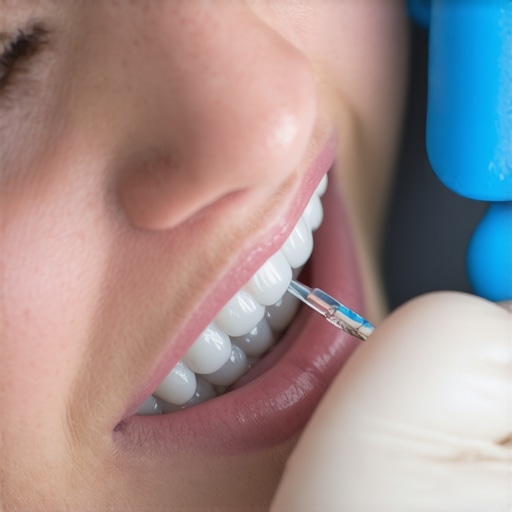
Don’t just tap your teeth together once and say “it’s fine” because you’re in a rush to leave the office. You need to grind your teeth side-to-side and front-to-back while biting on that thin strip of articulating paper. If you feel even a slight “snag,” speak up immediately. I once spent two weeks in agony because I was too polite to tell my dentist that my left molar hit a millisecond before the right one. That tiny delay was sending a shockwave of muscle tension up my neck and into my skull.
Why Your Jaw Muscle Is Working a Double Shift
When your bite is misaligned, your masseter muscles—the heavy lifters on the side of your face—never get a break. They are constantly firing to stabilize the jaw. This constant state of contraction is what triggers the tension that creeps up into your temples. You might notice that your teeth feel tight or your face feels fatigued after a long conversation. This isn’t just stress; it’s a structural imbalance. Many families overlook this during their routine family dentistry visits, assuming headaches are just a part of a busy life, but it’s often a simple mechanical fix.
Upgrade Your Hardware for a Better Alignment
If you are dealing with ancient amalgam fillings, they might be the culprit behind your recurring pain. Over decades, silver fillings can expand and contract, eventually micro-fracturing the tooth or changing shape enough to ruin your occlusion. Following the protocol for replacing an old silver filling with a composite or ceramic version allows for a much more precise “sculpting” of the tooth’s surface. This precision ensures that your teeth mesh like gears in a high-end watch rather than stones grinding together.
Preventive Maintenance Saves Your Sanity
The easiest way to catch these bite shifts before they turn into a three-day migraine is through consistent teeth cleaning appointments. During these sessions, we don’t just scrape away plaque; we look for wear facets—flat, shiny spots on your teeth that indicate you’re grinding or hitting too hard in one area. This is the cornerstone of maintaining oral health. If we see a wear facet on a filling, we can smooth it down in seconds, potentially saving you months of neurological pain. Don’t wait for the throb to start; proactive adjustments are the most effective preventive tips for a pain-free life.
Most people assume that cosmetic upgrades are purely about the ‘after’ photo, but the real magic happens in the mechanical alignment. If you are researching the impact of cosmetic dentistry, do not just focus on the shade of white. A skilled dentist uses veneers or crowns to rebuild the vertical dimension of your bite that may have collapsed over years of grinding. I have seen patients trade their migraine medication for a new set of restorations because the procedure finally gave their jaw the structural support it lacked. This is not just about vanity; it is about engineering a smile that does not fight against your muscles every time you swallow. However, here is where the ‘oops’ factor kicks in: many patients think that if a new filling or crown does not hurt immediately, it is perfect. This is a dangerous trap. Our bodies are incredibly good at adapting, even to things that are bad for us. You might subconsciously start chewing on one side or slightly tilting your head to avoid a high spot. You are not fixing the problem; you are just redistributing the stress to your neck and shoulders, leading to a delayed-onset headache that you would never think to link back to that ten-minute dental appointment. Have you ever fallen into this trap where you thought a dental weirdness just ‘went away’ on its own? Let me know in the comments.
Why your brain stops telling you that your bite is broken
This brings us to a fascinating nuance called proprioception. Your teeth are suspended in their sockets by the periodontal ligament (PDL). According to a study published in the Journal of Oral Rehabilitation, these ligaments are packed with mechanoreceptors that can detect a difference as tiny as 10 to 20 microns—less than the thickness of a human hair. When a filling is off, these sensors fire a warning. However, if the interference persists, your central nervous system may ‘mute’ the signal to prevent sensory overload. You stop feeling the ‘high’ tooth, but the masseter muscles keep firing in a state of high-alert to compensate. This is how a dental issue becomes a chronic neurological headache without you even realizing there is a mechanical cause. 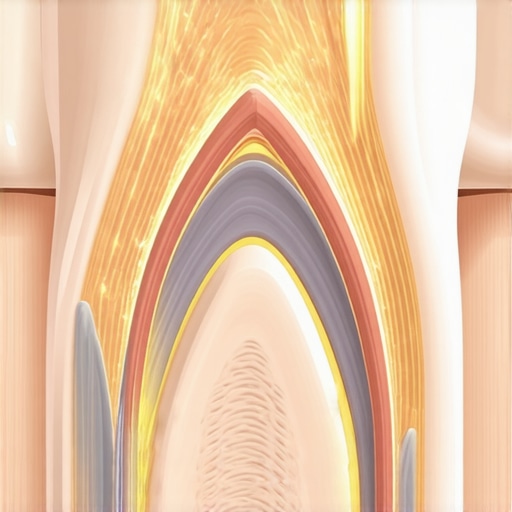
The Myth of the Simple Cleaning
Another common misconception is that teeth cleaning techniques are only about removing stains and plaque. In reality, a professional cleaning is a diagnostic sweep for mechanical failure. When you come in for maintaining oral health, your provider is looking for micro-fractures and wear facets that scream ‘misalignment’ before the pain even starts. This is one of the biggest oral health myths debunked: the idea that if your teeth look white, they are healthy. Truly effective family dentistry acts as a foundation where we monitor how a child’s bite develops or how an adult’s bite shifts over time. By following proactive preventive tips, you can catch these tiny ‘pebbles’ in your bite before they turn into a three-day migraine. Do not let your brain’s ability to adapt become your biggest health liability.
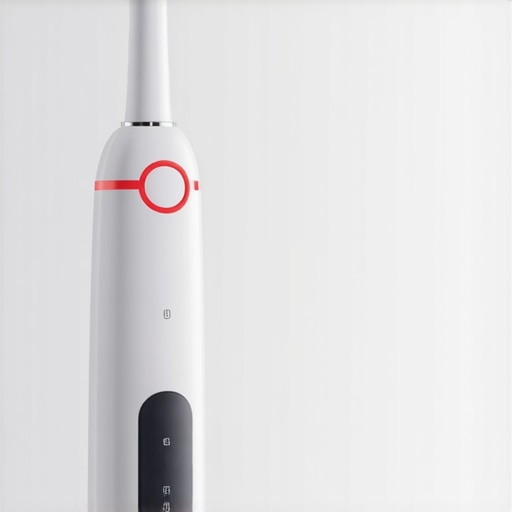
To break that cycle of adaptation, you have to switch from passive observation to active measurement. I stopped relying on how my teeth ‘felt’ and started looking at the data my tools provided. For instance, I transitioned to a sonic toothbrush with a built-in pressure sensor—not because I’m lazy, but because I’m aggressive. If that light flashes red, I know I’m putting undue stress on my periodontal ligaments, which are already working overtime to manage my slightly high filling. This is one of the many teeth cleaning secrets that pros use to prevent recession and sensitivity. It is about protecting the mechanical investment you have made in your mouth.
Stop Guessing and Invest in High-Pressure Sensors
The tech I recommend for anyone with a history of bite issues is the T-Scan system. Unlike the thin blue paper, which only shows where the teeth touch, the T-Scan is a digital sensor that shows the dentist exactly when and with how much force those teeth are hitting. According to clinical documentation from Tekscan, Inc., digital occlusal analysis allows for a level of precision that traditional methods simply cannot match, catching high spots that are invisible to the naked eye. If you are serious about maintaining oral health, ask your provider if they use digital bite mapping. It was the only way I finally found the micro-interference that was triggering my 2:00 PM temple throbs.
Keep Your Nightly Armor From Turning Into a Biohazard
If you have already realized you are a grinder, you likely have a night guard. But here is the catch: if that guard is not perfectly balanced, it can actually make your headaches worse by giving your jaw a new, uneven surface to chew on. Furthermore, if you are not careful, that piece of plastic becomes a breeding ground for bacteria. I personally use a dedicated ultrasonic cleaner for my appliance because brushing it with toothpaste actually creates micro-scratches where plaque can hide. Learning how to clean a nightguard properly is just as important as wearing it. While you are at it, do not skip the back of your tongue; it is why your dentist wants you to use a tongue scraper to reduce the overall bacterial load in your mouth, which can affect gum inflammation and, by extension, tooth stability.
How do I maintain my bite alignment over the next decade?
Maintenance is not a ‘one and done’ deal; it is an evolution. As we age, our teeth naturally shift and wear down. This is why I predict that within the next five years, we will see the rise of AI-integrated smart mouthguards that can track your bruxism patterns in real-time and alert your phone if your bite pressure shifts. For now, the best way to stay ahead is to stay informed about cosmetic dentistry innovations that focus on functional restoration. We are moving away from just ‘making things white’ and toward ‘making things work.’ By applying the top 5 secrets to maintaining perfect oral health as a family, you ensure that every member of your household is screened for these mechanical failures early. My advice? Next time you are brushing, pay close attention to your pressure sensor; if it turns red, you are not just cleaning—you are potentially pushing your bite out of alignment. Try lightening your grip for one week and see if that afternoon tension starts to fade.
What Most Doctors Miss About Your Morning Headaches
After years of navigating the intersection of dental mechanics and neurological pain, I have realized that the mouth is the body’s most sensitive early-warning system. Here are the core truths I wish I had embraced sooner:
- Adaptation is a trap: Just because you stopped feeling that new filling does not mean it is balanced. Your brain is simply ignoring the distress signal while your muscles pay the price.
- Precision is non-negotiable: When it comes to maintaining oral health, a millimeter is a mile. Never settle for a bite that feels “mostly okay.”
- The holistic connection is real: Your jaw alignment dictates the tension in your neck, shoulders, and eventually, your skull. Treating one without the other is like fixing a flat tire but ignoring the bent rim.
The Daily Gear That Keeps My Jaw Quiet
I do not leave my comfort to chance anymore. I have curated a small but powerful toolkit that helps me stay ahead of the curve. First, I prioritize teeth cleaning secrets like using an electric brush with a pressure sensor to ensure I am not irritating my periodontal ligaments. Second, I am a huge advocate for digital bite mapping—if your dentist does not offer it, it is worth finding one who does. Finally, applying the top 5 secrets to maintaining perfect oral health as a family has turned our bathroom routine into a preventive diagnostic session rather than just a chore.
Take the First Step Toward a Tension-Free Life
You do not have to live in a cycle of ibuprofen and darkened rooms. Your body is incredibly resilient, but it needs a level playing field—literally. By addressing the mechanical foundations of your smile, you are not just improving your looks; you are giving your nervous system the permission to finally relax. Whether you are looking into cosmetic dentistry innovations or just need a long-overdue adjustment, remember that a balanced bite is the cornerstone of long-term oral health. Don’t be afraid to ask for that extra minute of adjustment time; your future, headache-free self will thank you for it. If you are ready to find that “invisible pebble,” feel free to reach out to us through our contact page to get started. Have you ever felt a “click” or “pop” in your jaw after a dental visit that you just ignored? Let me know in the comments below!